Recent Posts

Scotland Yard lent police horse to Rebekah Brooks

Tuesday, 28 February 2012


The former Sun and News of the World editor was lent the horse in 2008, the year after Clive Goodman, who worked for her as royal editor of the News of the World, was jailed for phone-hacking along withe the private investigator Glenn Mulcaire. Officers from the Metropolitan Police Mounted Branch visited Mrs Brooks's home in the Cotswolds to check she had suitable facilities and was a competent rider before the horse went there. A spokesman for the Metropolitan Police pointed out that it is routine for retired Mounted Branch horses to be lent out to members of the public at the end of their working lives, but the arrangement is likely to raise fresh questions about the Met's relationship with Mrs Brooks. The news comes a day after the Leveson Inquiry was told that Mrs Brooks was briefed by a senior Met officer on the progress of the original phone-hacking inquiry and even consulted on how far she thought the investigation should go. Mrs Brooks, who is married to the former racehorse trainer Charlie Brooks, kept the horse at her home in the Cotswolds for two years before giving it back to the Metropolitan Police in 2010.  It was then found a new home in Norfolk with a serving police officer. Dave Wilson, Mrs Brooks's spokesman, said: "It's well known by people in the horse world that the Met looks for homes for horses once they retire. Rebekah took on a horse and effectively acted as a foster parent for it for a year or so. "The Met horse team comes out to make sure your facilities are right and proper. It's just a way of giving a temporary home to a horse that has had a distinguished service in the Met. It went off to a retirement paddock in Norfolk once it couldn't be ridden any more." At the time Mrs Brooks took on the horse, she was editor of The Sun, but had given evidence to a committee of MPs five years earlier admitting that the News of the World had paid policemen when she was editor of the Sunday paper between 2000 and 2003. By the time she gave the horse back to the Met she was chief executive of News International and the Met was facing calls to re-open its investigation into phone hacking following the disclosure that thousands of names of potential victims appeared in Mulcaire's notebooks. A spokesman for Scotland Yard said: "When a police horse reaches the end of its working life, Mounted Branch officers find it a suitable retirement home. Whilst responsibility for feeding the animal and paying vet bills passes to the person entrusted to its care at its new home, the horse remains the property of the Metropolitan Police Service. "Retired police horses are not sold on and can be returned to the care of the MPS at any time. In 2008 a retired MPS horse was loaned to Rebekah Brooks. The horse was subsequently re-housed with a police officer in 2010." The Metropolitan Police website states that: "At the end of the police horse's working life the animal is re-homed at one of many identified establishments who have previously contacted the Mounted Branch with a view to offering a home. "The Mounted Branch is looking for suitable homes for retired horses, that is homes where the horse will not be ridden. Anyone in the southeast of England offering such a home will be considered first."

READ MORE - Scotland Yard lent police horse to Rebekah Brooks

Bank tax dodges halted by retrospective law

Monday, 27 February 2012


A bank in the UK has been forced to pay more than half a billion pounds in tax which it had dodged by using "highly abusive" tax avoidance schemes. One tax dodge involved the bank claiming it should not have to pay corporation tax on profits made when buying back its own IOUs. The government said it would change the law retrospectively and immediately to stop anyone else using the scheme. The identity of the bank has so far not been revealed. Announcing the crackdown, the Exchequer Secretary to the Treasury, David Gauke, said the bank should never have devised the schemes in the first place. "The bank that disclosed these schemes to HM Revenue & Customs (HMRC) has adopted the Banking Code of Practice on Taxation which contains a commitment not to engage in tax avoidance," he said. "The government is clear that these are not transactions that a bank that has adopted the code should be undertaking. "We do not take today's action lightly, but the potential tax loss from this scheme and the history of previous abuse in this area mean that this is a circumstance where the decision to change the law with full retrospective effect is justified," he added. The second tax avoidance scheme, designed by the same bank, involved investment funds claiming that non-taxable income entitled the funds to tax credits that could be reclaimed from HMRC. The Treasury described this as "an attempt to secure 'repayment' from the Exchequer of tax that has not been paid". Compulsory notification A Treasury source suggested that outlawing the tax dodges immediately would save the government a further £2bn in tax that would otherwise have been foregone. The bank in question in fact disclosed the two schemes to the tax authorities under rules which have been in place since 2004. Anyone, such as a bank, accountant, lawyer or tax adviser, who devises a seemingly legal tax avoidance plan, is obliged to tell the tax authorities about it within a few days of using it or marketing it to clients. More than 2,000 schemes have been disclosed in the past eight years. "Quite a few of the disclosures have come from banks in the past," said John Whiting, of the Chartered Institute of Taxation (CIOT). "They are usually intended to sell to others such as clients." New code The banking code on taxation was first introduced by the Labour government in June 2009. It followed reports that some big banks used large scale tax avoidance schemes involving complex transactions and financial instruments. The code - which was supported by the incoming coalition government the following year - demands that banks which sign ensure that their tax and the tax obligations of their customers are observed. It says they should not go out of their way to avoid tax for themselves or clients. The 15 biggest banks operating in the UK have signed up. 'Treated even-handedly' In a separate development, HMRC said it would appoint a senior official to act as an "assurance commissioner" for any tax deals struck with big companies for more than £100m. The job of the commissioner will be to make sure taxpayers in general do not suffer from any such settlements. The move follows severe criticism last December from MPs on the public accounts committee who denounced HMRC for appearing to cut contentious tax deals with companies such as Vodafone and Goldman Sachs. Lin Homer, the new HMRC chief executive said: "This commissioner will take the role of challenging whether any proposed settlement secured the correct amount of tax efficiently and that taxpayers had been treated even-handedly." "The commissioner will also make sure that the governance procedures have been followed," she added.

READ MORE - Bank tax dodges halted by retrospective law

The daily Sun had systematically paid large sums of money to “a network of corrupted officials” in the British police, military and government.


A day after presiding over the publication of his new, damn-the-critics Sun on Sunday tabloid, Rupert Murdoch was confronted with fresh allegations from a top police investigator that the daily Sun had systematically paid large sums of money to “a network of corrupted officials” in the British police, military and government. Connect With Us on Twitter Follow @nytimesworld for international breaking news and headlines. Twitter List: Reporters and Editors Readers’ Comments Share your thoughts. Post a Comment » Read All Comments (130) » The allegations, part of a deepening criminal probe into The Sun and Mr. Murdoch’s defunct News of the World, highlight the challenges to Mr. Murdoch and his News Corporation as he seeks to minimize the threat to his British media holdings. They also cast a harsh spotlight on the freewheeling pay-for-information culture of the British media. In public testimony on Monday, Deputy Assistant Commissioner Sue Akers, who is leading the criminal investigation into Mr. Murdoch’s newspapers, said The Sun, long a source of special pride and attention for Mr. Murdoch, had illegally paid the unidentified officials hundreds of thousands of dollars in exchange for news tips and “salacious gossip.” She said the payments had been authorized “at a very senior level within the newspaper.” Her comments, unusual during a continuing criminal inquiry, directly undercut Mr. Murdoch’s campaign of support for the embattled newspaper. On Feb. 17, the 80-year-old Mr. Murdoch made a grand entrance into the Sun newsroom, where, marching around in shirtsleeves, he vowed to reinstate journalists suspended in the criminal investigation, offered to pay their legal bills, issued a robust statement about the paper’s probity and announced that he was defying conventional industry wisdom by starting a Sunday issue. Ms. Akers said illegal activities had been rife at the paper. “There appears to have been a culture at The Sun of illegal payments, and systems have been created to facilitate such payments whilst hiding the identity of the officials receiving the money,” she told the Leveson Inquiry on media ethics and practices, led by Lord Justice Leveson. The payments involved “frequent and sometimes significant sums of money” to public officials, she said. In a statement, Mr. Murdoch said that “the practices Sue Akers described at the Leveson Inquiry are ones of the past, and no longer exist at The Sun.” He remained publicly bullish, helping promote the new Sun on Sunday in newspaper stores and announcing on Twitter that it had sold 3.26 million copies. In another blow to Mr. Murdoch, related this time to The News of the World, a lawyer for the Leveson Inquiry said Rebekah Brooks, a former Murdoch executive, was apparently informed by the police in 2006 that detectives had evidence that the cellphones of dozens of celebrities, politicians and sports figures had been illegally hacked by an investigator working for the newspaper. The disclosure, contained in a September 2006 e-mail from a company lawyer to the editor of The News of the World, Andy Coulson, is highly significant. Until late in 2010, Mrs. Brooks, Mr. Coulson and other officials at News International, the British newspaper arm of News Corporation, repeatedly asserted that the hacking had been limited to a single “rogue reporter” — the paper’s royal correspondent, Clive Goodman. The assertion was rendered implausible, at best, by the fact that the police had information that so many hacking victims existed, and that so few of them had anything to do with the royal family. Monday’s disclosures could not have come at a more inopportune time for Mr. Murdoch. In recent weeks, morale at The Sun hit a low point after a number of senior editors and reporters were arrested on suspicion of illegally paying sources. At the same time, journalists at The Sun and elsewhere released a stream of angry attacks at the police, saying the investigation had gone too far and was targeting reporters for what they said was normal behavior in the British tabloid press like taking sources out to lunch or paying whistle-blowers. “The Sun journalists who have been arrested are not accused of enriching themselves — they were simply researching stories about scandals at hospitals, scandals at army bases and scandals in police stations that they believed their readers were entitled to know about,” Kelvin Mackenzie, a former editor of The Sun, wrote in The Daily Mail. “If the whistle-blower asks for money, so what?” The Metropolitan Police Service’s highly unusual decision to release specific details of a continuing investigation seemed designed to rebut such criticism. “The cases we are investigating are not ones involving the odd drink, or meal, to police officers or other public officials,” Ms. Akers said. “Instead, these are cases in which arrests have been made involving the delivery of regular, frequent and sometimes significant sums of money to small numbers of public officials by journalists.”

READ MORE - The daily Sun had systematically paid large sums of money to “a network of corrupted officials” in the British police, military and government.

European court rules against Italy for expelling migrants

Saturday, 25 February 2012


European Court of Human Rights (ECHR) on Thursday ruled that Italy had violated it human rights obligations when it deported a group of African migrants intercepted in the Mediterranean Sea to Libya in 2009. The decision delivered in Strasbourg by 17 judges of the court was described as a 'landmark' by the United Nation's Refugee Agency (UNHCR) and was also welcomed by several rights groups in Italy and elsewhere. Italy's International Cooperation Minister, Andrea Riccardi, said that the ruling would force Italy to 'think and rethink our policies towards migration.' The case concerned 24 Somalis and Eritreans who were in a group of 200 migrants intercepted by the Italian Coast Guard 35 nautical miles from the Italian island of Lampedusa.

READ MORE - European court rules against Italy for expelling migrants

Belarus fights Europe to retain death penalty


Belarusian MPs have blasted a recent resolution of the European Parliament on death penalty in Belarus as an attempt to interfere in the country’s internal affairs. The Belarusian parliamentary commission on international affairs has issued an official statement saying that the European Parliament’s resolution on the death penalty in Belarus was a continuation of the practice of pressuring Belarusian authorities and meddling with the country’s internal affairs. Additionally, the Belarusian side noted that from the text of the resolution they could draw a conclusion that the European side did not pay much attention to the credibility of facts and the logic of conclusions. In particular, the Belarusian parliamentarians criticized the fact that the case of Metro bombers Konovalov and Kovalyov, mentioned in the resolution, is called unjust, despite of the fact that the trial in the case was open to the maximum and well-covered by the media. The Belarusian politicians also expressed surprise over the fact that their country was called the Belarusian Federation in the European Parliament’s resolution, while its official name is Republic of Belarus. However, the text of the resolution posted on the European Parliament’s website in English uses the correct name. Belarusian MPs stressed that the use of capital punishment in their country is not against international norms and its use is extremely limited, and in practice happens only in extraordinary cases. The ban on capital punishment is the internal affair of the Republic of Belarus and can only be made with consideration of the Belarusian society’s opinion, the politicians said.

READ MORE - Belarus fights Europe to retain death penalty

Fishing skippers fined £720,000


Seventeen skippers behind one of Scotland's biggest fishing scams have been fined a total of £720,000. The group admitted making illegal landings of mackerel and herring worth £47.5 million between January 1 2002 and March 19 2005. The "black fish" scam, which broke sea fishing laws, was carried out at fish processing factory Shetland Catch in Lerwick, Shetland. Judge Lord Turnbull said the scam is "an episode of shame" for the pelagic fishing industry. He said it was a "cynical and sophisticated" operation which had the "connivance of a number of different interested parties". Hamish Slater, 53, and Alexander Masson, 66, both from Fraserburgh, were fined a respective £80,000 and £50,000, while Alexander Wiseman, 60, from Banff, was also fined £50,000. Another 13 men from Shetland were fined for their role in the scam. Robert Polson, 48, was fined £70,000; John Irvine, 68, was fined £80,000; William Williamson, 65, was fined £45,000; Laurence Irvine, 66, was fined £80,000; and David Hutchison, 66, was fined £40,000, as was 56-year-old Thomas Eunson. Both Allister Irvine, 63, and Gary Williamson, 52, were fined £35,000; and George Henry, 60, was fined £12,000. John Stewart, 57, was ordered to pay £15,000, while George Anderson, 56, must pay £12,000. Colin Leask, 39, and Allen Anderson, 55, were each fined £3,000 A £70,000 fine was imposed on Victor Buchini, 51, from Poulton-le-Fylde in Lancashire. The company Alexander Buchan was fined £240,000 for helping the vessel masters land the undeclared fish. The pelagic fishermen, who committed the offences to evade the annual EU fishing quota, had already been ordered to hand over almost £3 million in confiscation orders at a previous court hearing. The convictions came as the result of a seven-year investigation, Operation Trawler, after the Scottish Fisheries Protection Agency (SFPA), now Marine Scotland, became suspicious about widespread illegal landing of fish within the pelagic fleet. Pelagic fish are those which swim near the water's surface. Auditors KPMG reviewed Shetland Catch and found that between January 1 2002 and March 28 2004, the company's earnings were not supported by its declared landings. The company premises were searched on September 27 2005 and officials found that scales used to weigh fish coming into the factory had been manipulated to provide false weights. Management were able to input fake wastage figures into a computer in the main factory, accessible to inspectors from the SFPA, which would be deducted from the actual weight shown on the screen. The proper weight was displayed on screens in the engineer's room and in a loft area, both of which were off-limits to SFPA officials. The computer in the loft area was where the weight manipulation took place. It could be accessed remotely by two members of staff, a fish buyer and the then assisting managing director, using a username and password, allowing them to program it to provide false weights. Lord Turnbull said the proceedings brought "embarrassment and shame" to the skippers and their families. He said: "All of the accused who appear today have spent their working lives as productive and hard-working members of our community. Barring other regulatory infringements, not a single one has ever come into any conflict with the law. "It was not surprising therefore to hear of the well-respected positions within their communities which many held and of the embarrassment and shame which these proceedings have brought to them personally and to their families." The judge said the fishing industry "makes a crucial contribution" to the well-being of many communities and to the economy of the country as a whole. He added: "There would of course be no fishing industry were it not for the willingness of fishermen to go to sea. It is correct to acknowledge that in doing so,fishermen require to cope with challenging circumstances of isolation from family members and often with dangerous and frightening weather conditions, the likes of which will be wholly unfamiliar to others with more conventional working environments. "Over the history of the fishing industry and even in recent times in Scotland, tragedy has often visited the families of those who spend their working lives at sea." The judge also noted that each master involved "made no attempt" to disguise their true income from the fish and paid income tax on both the declared and undeclared landings. But he said the men had all participated in "a deliberate and calculated determination to evade the quota levels for fishing available to each vessel" for "purely financial" reasons. He said: "The system through which this was achieved was both cynical and sophisticated and involved the connivance of a number of different interested parties, some of whom have benefited but have not been prosecuted. "The extent to which landings of fish were deliberately under-declared was at times truly staggering and in the case of some of the accused concerned, took place continuously over a three-year period. "What I found to be noteworthy was that no understandable explanation was provided on behalf of any the vessel masters as to why this practice was commenced or continued with. "No one for example appears to have engaged in this exercise on account of struggling to cope financially with the costs of continued fishing within the quota levels allocated. "Indeed, in contrast to some within the fishing industry, those engaged in fishing with the pelagic fleet appear to have been able to make very substantial sums over many years, providing very comfortable livings for themselves and their families. "In short then, and as was conceded by at least some of those who appeared before me, the motivation for the sustained furnishing of false information was purely financial. Those who were already making a good living saw this as a way in which more income could be generated. "No doubt the fact that so many were involved lent a veneer of acceptability to the conduct but there is another side to that as well: the fact that so many were prepared to participate in deliberate lies and falsehood means that the desire for financial benefit was able to overshadow the instincts of fairness, truthfulness and responsibility which will have influenced every other aspect of the lives of those concerned and which values they would expect to see others, including their own family members, abide by. "The result is an episode of shame for much of the whole pelagic fishing industry. "I have however accepted in each case that these proceedings have been responded to responsibly and that those concerned regret their involvement and the embarrassment which has been brought to them personally and to their families." The men had previously been subjected to a reduced quota of fish to "balance out" the environmental effect of years of overfishing. But the judge insisted that this was not a punishment but an "exercise in conservation". He said: "I do not accept that the accused in this case have lost out or have been made worse off as a consequence of these arrangements. I accept as accurate the observation that looking back with hindsight had they never over-fished at all then they would have achieved a greater income over the extended period than they in fact have. "That is due to the massive increase in the prices obtained for the type of fish with which I am concerned in the period since 2002. That however is no more than an irony of the situation. It does not reflect any actual loss to those concerned. In fact, as a consequence of the increased value of the fish, those involved have still been able to generate very substantial incomes, despite being restricted to catching a smaller quantity. "If the current prices remain stable then when the quota deduction arrangements have been exhausted, they will be in a position to increase that income even further." He also referred to "activities of foreign fishing vessels" in exceeding fishing quotas. The judge said: "If there is an imbalance in the approach of the relevant authorities within the European Union, that is a matter for the relevant ministers to raise with their counterparts. "If vessels belonging to states outwith the European Union are thought to enjoy some inappropriate benefit or are not thought to be complying with their responsibilities concerning stock conservation, that is a matter to be addressed at governmental or international level. "I am dealing with the contravention of a law of this country which was introduced to ensure compliance with the international obligation which the United Kingdom had entered into. "I am entitled to treat that contravention as a serious matter regardless of how it might be thought that similar conduct would be or has been responded to elsewhere." Three more fishermen pleaded guilty today in a separate case but which was part of the same investigation. James Smith, 54, from Fraserburgh, John Smith, 36, from Peterhead and Stephen Bellamy, 59, from Fraserburgh all admitted landing undeclared fish at Fresh Catch in Peterhead and at Shetland Catch in Lerwick. Sentencing was deferred to May 18. An inspection in November 2005 at the Alexander Buchan firm detected an unofficial weigh belt fitted with "load cells" to the conveyor belt system at the point where fish entered the factory. The cells are used to detect the weight of fish passing over the belt. A deflector plate had been used on the unofficial weigh belt, allowing the fish to drop off part of the way along the official scales. As the fish did not travel over the full area, a lower weight was achieved on the counter. This method is said to have allowed up to 70% of a total landing to go unrecorded. Alexander Buchan, which is no longer trading, has already been ordered to pay £165,000 in a confiscation order. A third fish processing factory, Fresh Catch, also admitted helping vessel masters land undeclared fish between October 20 2002 and September 2 2005 at its premises in Kirk Square near Peterhead. Skippers Ernest Simpson, 64, from Fraserburgh, Allan Simpson, 42, from Fraserburgh, and Oswald McRonald, 63, from Banff, pleaded guilty at the High Court in Glasgow today to landing undeclared fish at the factory. Their sentences were also deferred until May 18. Fresh Catch was audited by KPMG during the same period as Shetland Catch and it too was found to have earnings unsupported by official landing figures. At the factory, fish entered via a delivery pipe which went up and over the building. However, a search of the premises in September 2005 uncovered a purpose-built pipe, leading underground, was also connected. This second pipe bypassed the official weigh scale. Knife valves were used to divert the fish when they came to a T-junction, allowing fish to be sent to another part of the factory and was never weighed or officially accounted for. In 2005 the two valves become remote controlled and the direction the fish took at the junction depended on which one was open or closed. Fresh Catch only became significantly operational at around the time the scam began. Cephas Ralph, head of compliance at Marine Scotland, said the divert pipe "certainly served no other purpose" and that "it wasn't put there by accident". All three factories were prosecuted out of Operation Trawler which started in 2005. However, nothing suggested any of the plants were linked. At the time of the undeclared landings, Shetland Catch was the largest pelagic fish processing operator in Scotland and one of the largest in Europe. It was able to process and freeze up to 1,000 tonnes of fish a day. EU regulations state that when a vessel reaches its quota, it has the option to either stop fishing or to buy some of another vessel's quota which has not yet been reached. Any vessel which exceeds its quota faces disciplinary action. When the investigation started 26 vessels were in the pelagic fleet, with eight pelagic fish processing factories. More than half (15) of those boats have been prosecuted. Mr Ralph said the investigation had an immediate effect on the entire industry and that Marine Scotland is now satisfied that legislation is in place to ensure a similar scam does not happen again. He said: "Since 2005 we detected a change which spilled out beyond the pelagic industry. It is more important to the vessels to have a good reputation. "It is fair to say we are satisfied that we have inspection procedures, legislation, a mindset in place in the industry that means if such activity was to recommence, it would be quickly detected and dealt with. "We have not had anything similar since these cases and all our intelligence suggests that no similar activities are taking place." Afterwards Lindsey Miller, head of the serious and organised crime division of the Crown Office, said: "Organised crime takes many forms. These individuals may not have been involved in drug dealing or prostitution but let us make no mistake that they were involved in significant and serious organised criminality." She added: "The legislation is there to protect the marine environment for the good of all and to safeguard the future of the fishing industry. These men disregarded it for their own financial gain and, in a clear example of successful working between the law enforcement agencies involved, have now been brought to justice and made to pay for their crimes." The police investigation was led by Detective Superintendent Gordon Gibson of Grampian Police who said the scale of the crime is of "a level rarely seen before". The men involved "amassed huge sums of money through their own greed and today this caught up with them in a court of law", he added. Meanwhile, Cephas Ralph said: "Today's successful court activity is an outcome that reflects the professionalism, dedication and commitment shown by all of the Marine Scotland staff who have been involved in this inquiry. "It has not been an easy task but they have worked tirelessly to help secure the convictions obtained in these important cases." Scottish Environment Secretary Richard Lochhead paid tribute to the police and Marine Scotland for their efforts in "a long and vastly complicated inquiry". He said: "There is no doubt that these illegal activities are a stark and shameful reminder of the culture that existed in some sectors of the fishing industry in past years. But they do not reflect the much-improved culture we see today. "The offences date back up to a decade ago and thankfully there has been seismic change in the attitude and behaviour of the fishing fleet, which can only be good thing in securing a viable future for the industry in Scotland." He also said: "There have been significant advances in recent years in how fish landings are monitored and controlled, including comprehensive audits and certified weighing systems." Dr Mireille Thom, senior marine policy officer at WWF Scotland, said ignoring quotas "isn't a victim-less offence" because "such landings not only undermine the conservation of fish stocks and the fortune of the fleets that fish them, they also distort competition by depressing fish prices. In short, they threaten the public good for the benefit of a few".

READ MORE - Fishing skippers fined £720,000

Police uncover 'serious and organised' criminality in £63m scam to breach European fishing quotas

An inquiry into the UK's largest fishing scandal has uncovered "serious and organised" criminality by Scottish trawlermen and fish processors in an elaborate scam to illegally sell nearly £63m of undeclared fish.

Three large fish factories and 27 skippers have pleaded guilty to sophisticated and lucrative schemes to breach EU fishing quotas, in what one senior police officer described as "industrial level" deception.

They went to extraordinary lengths to conceal their illegally caught fish, installing underground pipelines, secret weighing machines and extra conveyor belts and computers to allow them to land 170,000 tonnes above their EU quota of mackerel and herring between 2002 and 2005.

The extent of the "black landings" scandal emerged as 17 skippers and one of the three factories were given fines totalling nearly £1m at the high court in Glasgow on Friday, after admitting repeated breaches of the Sea Fishing (Enforcement of Community Control Measures) (Scotland) Order 2000. Another six skippers pleaded guilty at the same hearing to landing undeclared fish worth nearly £7m at Lerwick, in the Shetlands, and Peterhead, Aberdeenshire.

Four skippers pleaded guilty in January and a further four in the ring, who can't be named for legal reasons, are still to be prosecuted.

Judge Lord Turnbull, told the 17 skippers sentenced on Friday they were guilty of a "cynical and sophisticated" operation, which brought embarrassment and shameon them and their families. "The motivation was purely financial," he said. "Those who were already making a good living saw this as a way more income could be generated and were prepared to participate in deliberate lies and falsehoods."

Once the illegally caught fish had been sneaked past Government inspectors, it was put on sale in the Lerwick and Peterhead markets, where it was sold to wholesalers and fishmongers as if it had been legally landed, in defiance of strict EU regulations designed to protectEurope's fish stocks from over-fishing.

The Guardian can reveal that the illegally landed fish was sold with the knowledge of the government-funded industry marketing authority Seafish, which took a £2.58 levy for every tonne of over-quota mackerel and herring. That earned it £434,000 in fees before the Scottish Fisheries Protection Agency, now part of Marine Scotland, raided two factories in September 2005.

The headquarters of Seafish in Edinburgh were raided by police and documents seized in 2008, but five months later prosecutors decided not to take any further action. It is thought the Crown Office, the Scottish prosecution body, believed there was no evidence that could lead to the agency being accused of involvement in the scam.

With a series of court cases stretching back to 2010, the scandal has implicated more than half the Scottish mackerel and herring fleet active at that time. It is understood that the true value of the illegal landings linked to the factories involved is closer to £100m, but prosecutors decided to pursue just £63m of landings.
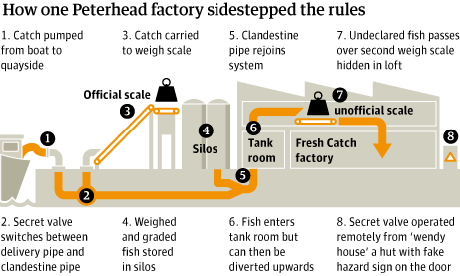
Black fish factory graphicHow one Peterhead factory sidestepped the rules. Source: Guardian graphics

Prosecutors have also confiscated £3.1m from 17 skippers who landed catches in Lerwick, and against two of the three firms so far convicted, under proceedings of crime legislation introduced to tackle serious criminal gangs and drugs lords. The largest confiscation order, £425,9000, was against Hamish Slater, the skipper of the trawler Enterprise from Fraserburgh, Aberdeenshire, who admitted landing £3,980,000 worth of undeclared fish. A number of skippers landed fish worth more than £2m.

At Shetland Catch in Lerwick, one of Europe's largest fish processors, the company installed a duplicate conveyor belt when its new factory was built, fitting a secret weight-reading device in the loft and a computer in an engineer's workshop "a considerable distance" from the factory floor.

In its processing plant at Peterhead, north of Aberdeen, Fresh Catch installed an underground pipe to divert fish to secret weighing devices, which used remotely operated pneumatic valves. It built a secret storage room, and operated the clandestine machinery from a hut known to workers as the Wendy House, disguised with fake "Danger: high voltage" signs on its door.

A second factory in the town, Alexander Buchan, which has since closed, fitted a secret scale and conveyor belt, which allowed up to 70% of a boat's catch to go undeclared. It printed a guidance manual showing its staff how to handle undeclared landings, and its staff misled trading standards officers about its purpose.

Detective Superintendent Gordon Gibson, of Grampian police, the senior investigating officer in Operation Trawler, said: "Make no bones about it: it was serious, it was organised and it was criminal. The element of preparation involved was significant, given the methods and means that all these individuals went to.

"Was I surprised? Absolutely. I was surprised at the levels they had gone to disguise their criminal conduct."

An industry source admitted: "This wasn't casual or by accident. It was organised, it was systematic, it was deception. No one disagrees with that."

In a further penalty, which is thought to have cost the convicted skippers millions, the European commission cut the quotas soon after the scandal was reported to Brussels by the UK government in 2005, calling it a "quota payback".

Although none of the trawlermen have been banned from fishing, their quotas were cut by more than 116,000 tonnes of mackerel and nearly 47,000 tonnes of herring over a seven-year period. That payback will end next year.

One source with detailed knowledge of the case said this had damaging consequences for skippers and crews involved, as the market value of mackerel and herring since 2005 had been as much as double the price 10 years ago.

The convictions follow a complex, 10-year investigation involving forensic accountants from KPMG, who analysed the paperwork for thousands of landings, a core team of 25 detectives and support staff from Grampian and Northern police, four British sea fishery officers with Marine Scotland, the Home Office Holmes police computer system, money laundering experts with the Scottish Crime and Drug Enforcement Agency, and specialist prosecutors at the Crown Office.

Operation Trawler has brought to an end a practice which was once endemic in the British fishing industry, but has been made extremely difficult by hi-tech monitoring and tracking of every registered trawler at sea, and much tighter controls on landings at processing firms.

The skippers and firms involved have refused to discuss their convictions; Shetland Catch is still facing confiscation proceedings. But sources with detailed knowledge of the scandal have admitted the practice was widespread within the pelagic fishing industry. Lawyers for one of the convicted men, George Anderson, 55, from Whalsay, Shetland, claimed this year that he evaded the controls because he believed that discarding under-sized fish was "repugnant".

"Black landings" are still common practice across the EU, and prosecutions still take place. In Lerwick and Peterhead, some insist that the undeclared landings, which helped many of the skippers and their crews enjoy comparatively luxurious lifestyles, were well-known within the industry and among regulators.

Asked about its knowledge of the illegal landings, Seafish told the Guardian it was legally required to take the levy, and insisted it had tipped off the authorities to the over-quota landings. However, one source said that the issue was discussed in board meetings, "but the Seafish line was that we weren't a fishery protection agency, our job was to take a levy on every tonne landed."

He added: "They were totally aware they were getting a levy on quota and over-quota fish."

The source denied it was serious and organised crime: the skippers involved paid income tax and business taxes alongside the Seafish levy on all their illegal landings, largely because the over-quota fish was sold in the fish markets as if it were legally declared. Fraud charges were dropped by prosecutors at an early stage, he said.

But he added: "There is nobody defending this. It was morally wrong; it was ecologically wrong and sustainably wrong. There is no excuse.

"A lot of the skippers are saying, 'What we did wasn't right; it was wrong. We really want to draw a line under this and move forward.'"

He said the scandal had the effect of transforming Scotland's pelagic fishing industry into one of the most sustainable in the world: after the raids, the mackerel and herring fleet introduced very strict monitoring and quota management. Since 2008, its fisheries have won a prized Marine Stewardship Council eco-label, and are now the largest in Europe with MSC certification.

But the "black landings" scandal is coming back to haunt the industry. It is expected to lose its MSC accreditation later this year after a bitter dispute with the Faroe Islands and Iceland: both countries have claimed much larger mackerel quotas than is sustainable for the north-east Atlantic stocks, in breach of MSC rules. The Faroese in particular believe the over-quota prosecutions puts the Scottish industry's credibility in severe doubt.

"It's not a proud moment for what is a very proud industry," one senior figure conceded.

Richard Lochhead, the Scottish agriculture secretary, said the convicted were guilty of appalling behaviour. "These illegal activities are a stark and shameful reminder of the culture that existed in some sectors of the fishing industry in past years," he said.

"Thankfully, there has been seismic change in the attitude and behaviour of the fishing fleet, which can only be good thing in securing a viable future for the industry."

Dr Mireille Thom, a senior marine policy officer for the conservation group WWF Scotland, said: "Deliberately ignoring quota rules by landing 'black fish' isn't a victimless offence. Such landings not only undermine the conservation of fish stocks and the fortune of the fleets that fish them, they also distort competition by depressing fish prices. In short, they threaten the public good for the benefit of a few."

READ MORE - Police uncover 'serious and organised' criminality in £63m scam to breach European fishing quotas

. Ronald Herron, who calls himself "The Big Homie," dabbled as a self-styled rapper under the name "Ra Diggs" until he was busted in 2010

Tuesday, 14 February 2012


The leader of all Bloods street gangs in New York City was hit with a sweeping new indictment today charging him with murder and several murder conspiracy charges. Ronald Herron, who calls himself "The Big Homie," dabbled as a self-styled rapper under the name "Ra Diggs" until he was busted in 2010 after a four-year FBI-NYPD probe involving more than 65 undercover drug purchases. Brooklyn federal prosecutors say he unleashed a reign of terror over several city housing projects, threatened the police, vowed online to "turn the pigs kids into" orphans, and issued warnings against snitching. Today prosecutors hit him with an expanded indictment that includes several murder, murder conspiracy, and attempted murder charges related to his alleged drug business, and Herron possibly could face the death penalty, if convicted. He was already facing cocaine and heroin-trafficking charges - as well as weapons offenses - that stemmed from his 2010 arrest. The feds say he’s carried sub-machine guns, strapped on bulletproof vests, and authorities believe he's responsible for ordering murders and intimidating witnesses that doomed one homicide prosecution in New York state court. Last summer - while fighting the earlier federal drug charges - Herron claimed that he was not bound by American law. "I am not a party to ... the Constitution of the United States of America," Herron wrote Brooklyn federal Judge Nicholas Garaufis. Arguing that he was a “sovereign inhabitant” not subject to federal jurisdiction, he also made a contradictory argument that he’s governed only by the US Constitution and no other laws passed since the Founding Fathers penned that original document. Herron’s philosophy includes concepts espoused by certain grass-roots political movements in the western US, which Constitutional law experts say was a “fascinating” development. “Surprisingly, some of the things he says here are popular with white supremacist groups,” Larry Solum, a professor at Georgetown University’s law school, told The Post last summer. Herron’s challenge also uses “similar ideas to those associated with extremist and fringe movements,” such as the Patriot movement and militia groups," said Solum, a constitutional scholar. But the judge was not persuaded and rejected Herron's motion suggesting that his earlier drug trafficking indictment be dismissed.
READ MORE - . Ronald Herron, who calls himself "The Big Homie," dabbled as a self-styled rapper under the name "Ra Diggs" until he was busted in 2010

2 charged in turf warfare |

Two London men face multiple arson charges stemming from three fires reported within 35 minutes of each other at two massage parlours Jan. 8. The blazes broke out during a week of mayhem in London early in January that brought fires and shootings, with outlaw biker and street gang undertones. David Hewlett-Weiler, 28, faces three counts of arson or explosion causing property damage, and another three of throwing an explosive with intended property damage in relation to the fires at massage parlours Blue Lagoon II at 1180 Oxford St. E. and Virginia's, located at 125 Clark Rd. Blue Lagoon II sustained $150,000 in damage after it was set on fire in the early morning of Jan. 8. About 20 minutes later, Famous Flesh Gordon's went up in smoke, causing $10,000 damage. No one has been arrested for that fire. Just 10 minutes after those dramatics, firefighters raced to Virginia's to battle that blaze. The fire there caused an estimated $25,000 damage. Blue Lagoon II was the target of an arson three days earlier, which caused $1,250 damage. Michael Morrison, 21, of London is charged with a single count of arson causing property damage and another of throwing an explosive with intended property damage in relation to that incident. Neither of the suspects is a member of a biker or street gang, London Const. Dennis Rivest said, but he cautioned the investigation continues to see if they have ties to organized crime. Hewlett-Weiler lists himself as the owner of LDM Roofing on his Facebook page. It's been speculated the fires were a signal that long-dormant biker wars were heating up once again, though that has yet to be proven. Flesh Gordon's is owned by Rob Barletta, a former London Hells Angels chapter president and current member.

READ MORE - 2 charged in turf warfare |

Brussels gives green light for storage of Olive Oil

Monday, 6 February 2012


The European Commission is to give the green light this month for a new storage of olive oil for as much as 100,000 tons for five months. Taking that amount from the marketplace means that prices will be controlled. A similar amount was stored last November and since then only 45,000 tons has been released from cooperatives and some industrial groups. The olive oil sector is in a deep crisis with very low prices over the past year, a lower quality of product and an average 155 € per kilo for normal, and under 2 € for virgin extra. EU aid of between 80cents and 1€ only partially solved the problem and so producers are turning to storing the oil to put up the price. Minister for Agriculture, Arias Cañete, considers storage to be just another measure. Last season 1.4 million tons were produced, an amount expected to be beaten this year.

READ MORE - Brussels gives green light for storage of Olive Oil

Fire affects 500 hectares of the Sierranía de Ronda


500 hectares in five municipalities of the Sierranía de Ronda was affected by fire over the weekend. It started on Saturday in Pujerra, Málaga, and was not brought under control until Sunday. The Junta de Andalucía has said that cork oaks, pines and shrub were all affected and the UME, Military Emergency Unit was called into assist INFOCA. The strong winds in the area, upto 40kms/hour on Saturday, complicated the control of the fire, and the fire-fighters continued their work on Saturday night despite temperatures of -4ºC. More than 240 people took part in fighting the fire, using four helicopters and five amphibious planes. There were no injuries and nobody had to be moved from their homes.

READ MORE - Fire affects 500 hectares of the Sierranía de Ronda

German nationals face death penalty over drug smuggling charges in Malaysia

Thursday, 2 February 2012


A district court near the Kuala Lumpur International Airport charged the three men on January 13 with drug trafficking, said a customs official who declined to be named. Airport officials arrested the men arriving from Istanbul on January 1 after finding 10.2 kilogrammes of methamphetamine hidden in the bags they were carrying, the official said on Wednesday. He said no plea had been recorded from the three pending the case's transfer to a high court once a chemist report on the drugs is ready. The two Germans have parents from Afghanistan but were born in Germany, while the Moroccan has lived in Germany for 15 years, the official said. Authorities in the Southeast Asian country went on "red alert" late last year following a surge in arrests and drug seizures, tightening passenger and luggage screening.

READ MORE - German nationals face death penalty over drug smuggling charges in Malaysia

Times of London Dragged Into UK's Hacking Scandal - Another Rupert Murdoch newspaper being probed, says lawmaker


Police are investigating alleged email interception by Rupert Murdoch's Times of London, a British lawmaker said today—dragging Britain's oldest national newspaper into the broadening scandal over press wrongdoing. Labour Party legislator Tom Watson, who helped lift the lid on tabloid phone hacking, released a letter from police confirming they were investigating alleged email hacking by the Times. The 226-year-old Times has acknowledged that a former reporter tried to intercept emails in 2009 to unmask an anonymous policeman who blogged as NightJack. Editor James Harding told Britain's media ethics inquiry last month that the reporter had acted on his own and had been reprimanded. The paper later published the blogger's name, but Harding insisted it had been obtained by legal means. In the wake of the new development, Harding will be summoned back to give further testimony to the judge-led ethics inquiry.

READ MORE - Times of London Dragged Into UK's Hacking Scandal - Another Rupert Murdoch newspaper being probed, says lawmaker

Five Britons in court in UK for Mallorca pyramid fraud

Wednesday, 1 February 2012


Five British citizens are in court in the United Kingdom shortly for having allegedly set up a pyramid selling fraud which resulted in 70 residents of Calvià on Mallorca being defrauded out of 12 million €. They are alleged to have captured 150 investors in several countries, promising enormous profits on the stock market from a company called Gilher Inc. The accused are charged with massive fraud, money laundering in Panama and the Seychelles, although they are all claiming innocence. The Serious Fraud Office says the operation started in 2001 and has named the main accused as 60 year old John Hirst, from Brighouse, and Richard John Pollet from Poole, both of whom had luxury villas in Calvià with an active social life. They were members of Mallorca Cricket Club and the Rotary Club, and they offered interest of up to 18%. It was 1.5% return per month, making 18% per annum, and a 2% bonus was paid if invested for a year. Police say that they managed to capture as many as 70 British residents of Mallorca, mostly retired people who often handed over their life savings and sums of between 11,000 and 223,000 €. Similar numbers of victims were seen in France and the United States, who paid over some 12 million € in total under the promise of large profits. Problems started at the end of 2009 when the first complaints about fraud were seen. Hirst and Pollet have both denied the charges when they appeared at Bradford Crown Court in a plea and case-management hearing. Hirst pleaded not guilty to money laundering linked to a 33,000 pound transfer from the Bank of Cyprus to Gilher Inc, and a 428,000 pound investment in Last Second Tickets Limited. His wife Linda, pleaded not guilty to various money laundering charges including one related to the purchase of a 552,000 pound house with her daughter Zoe in Send, Surrey in 2008. All five defendants were granted bail until the pre-trial hearing which is expected on April 20, and Judge Durham Hall has confirmed the trial date has been set for June 18. It’s expected to last eight weeks.

READ MORE - Five Britons in court in UK for Mallorca pyramid fraud

Related Posts Plugin for WordPress, Blogger...